



Fascial manipulation® - Practical part - Second Level
di Stecco - Stecco • 2026 • dettagli prodotto
normalmente disponibile
per la spedizione in 5-7 giorni lavorativi
da
a
€ 45,60


DESCRIZIONE
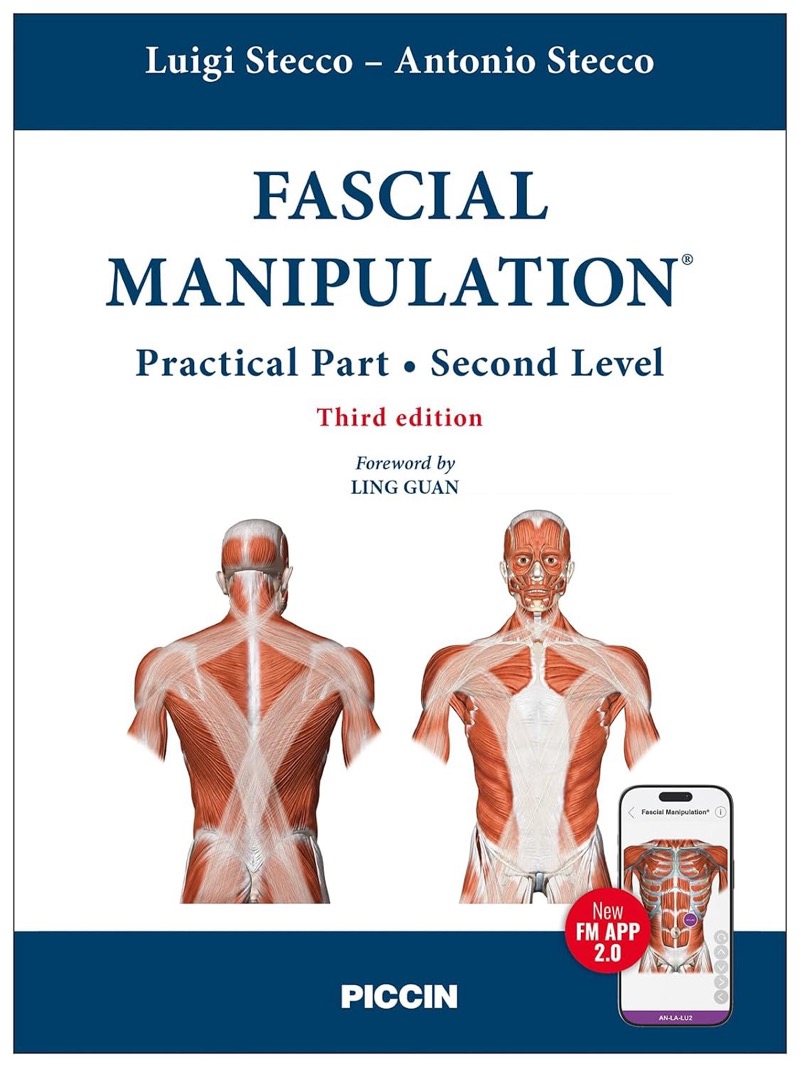
The two images on the cover of this book are similar to those on the cover of a book we published in 2002. In that book, the myofascial spirals and their role in the management of complex movements were introduced for the first time.
In humans, walking is one of these complex movements. Walking is not only coordinated by nerve impulses generated in the brain but also by collagenic pulleys in the periphery that, similar to the strings of a puppet, synchronise the movements of the lower limb with the contralateral upper limb.
Various instruments are currently used to analyse the biomechanics of gait. However, these instruments do not explain how the brain simultaneously manages the kinematics of walking and any dynamic modifications that may occur along its normal trajectory. If, for example, a person stumbles as they are walking, then there has to be a rapid reorganisation of all the motor schemes. If there wasn’t a peripheral motor coordination that anticipates the afferents to the brain and the efferents to the different muscles, then the person would fall.
Stretch of the fascia acts on the muscle spindles and Golgi tendon organs, causing rapid activation of the motor schemes that can support a new event. This stretch is not casual. It is organised according to myofascial sequences, diagonals and spirals.
Specific analysis of only the spiral-form collagen fibres that coordinate the pelvic and shoulder girdles during walking, reveals that:
• starting from the lower limb, the pelvis on the right is in a position of anterior adduction (anme-pv centre of fusion (CF)), which allows the hip (coxa) to move anteriorly and laterally (an-lacx CF). This movement stretches the oblique collagen fibres of the abdominal fascia that extend to the contralateral pectoralis major
• the scapula on the left is in a position of anterior adduction (an-me-sc CF), which allows the left humerus to move anteriorly and laterally (an-lahu CF).
By examining the short posterior spiral of the trunk, which synchronises the movement of the two girdles, it can be observed that:
• on the left, the pelvis is in a position of posterior adduction (re-me-pv CF), which allows the coxa segment to move posteriorly and laterally (rela-cx CF). Tension ascends from these collagen fibres to the contralateral shoulder girdle via the collagen fibres within the aponeurosis of latissimus dorsi
• the scapula on the right is in a position of posterior adduction (re-me-sc CF), which allows the right humerus to move posteriorly and laterally (re-la-hu CF).
In order for the collagen fibres of ante-medio-pelvis to connect with those of the contralateral ante-medio scapula, they have to cross over the midline, proximal to the umbilicus. The same occurs for the collagen fibres that connect the CFs of ante-latero-coxa and ante-latero-humerus.
In the posterior trunk, the collagen fibres of retro-medio-scapula descend along the trapezius and, by following the inferior part of this muscle, pass to the contralateral side. The collagen fibres of retro-latero-humerus initially follow the direction of the latissimus dorsi, and then cross over to the contralateral gluteus maximus.
To carry out movement in a spiral, the CFs of the pelvis, coxa, scapula and humerus segments all connect with the large trunk muscles (gluteus maximus, deltoid, latissimus dorsi, obliques, etc.). The fasciae of these large muscles extend into the limbs to form the aponeurotic fascia (fascia lata, brachial fascia, etc.).
At the level of the wrist (carpus) and ankle (talus), this aponeurotic fascia contains the retinacula of the flexor and extensor muscles, and the small muscles of the hands and feet, the extremities of the limbs, take origin from these retinacula.
The movements of these extremities, which are programmed by the brain, also generate a distal-proximal tension on the spiral-form fibres that are contained within the aponeurotic fascia. Continuity between the collagen fibres in the foot and those in the lower limb allows for those essential postural adjustments that, for example, occur if a person stumbles as they are walking. Continuity between the collagen fibres in the hand and the more proximal fibres in the forearm and arm allows adjustments to occur in the proximal segments in response to the task being performed in the extremity.
DETTAGLI PRODOTTO torna su
ISBN: 9788829936670
Titolo: Fascial manipulation® - Practical part - Second Level
Autori: Stecco - Stecco
Editore: Piccin
Volume: Unico
Edizione: III 2026
Lingua: Inglese
Finitura: Copertina flessibile
Misure: 19,5x28,5 cm
Pagine: 304
Peso: 1 kg
RECENSIONI
NESSUNA RECENSIONE PER QUESTO PRODOTTO